
How to Choose the Best Laser Equipment for Your Business
Choosing the right Laser Equipment can shape your production quality, operating costs, and long-term business stability. A polished brochure is not enough. The machine must suit your materials, workspace, team, and daily workload.
Dr. Theodore Maiman, a pioneering laser engineer, is often credited with saying, “The laser is a solution looking for a problem.” That warning still matters. Buying powerful equipment without a defined application can create expensive downtime. A small fabrication shop may need a compact fiber laser, while a medical or cosmetic business may require carefully controlled energy levels, ergonomic design, and documented safety procedures. The best choice depends on purpose, not prestige.
Look closely at cutting speed, beam quality, cooling requirements, software, maintenance access, and operator training. Ask how the equipment performs after months of use, not only during a showroom demonstration. Check service response times, spare-part availability, warranty terms, and the supplier’s technical credentials. These details often determine whether a machine becomes a productive asset or a costly obstacle.
There is no perfect specification sheet.
A reliable evaluation should include sample testing with your actual materials. Watch the operator load the machine, align the settings, and inspect the finished edge under normal lighting. Reflect on weaknesses, too. Your team may need more training than expected. Your floor may lack sufficient ventilation or stable power. Honest planning is less exciting, but it protects customers, employees, and investment. This guide explains how to compare Laser Equipment with practical judgment, measurable criteria, and realistic expectations.
Define Your Business Goals and Laser Application Requirements
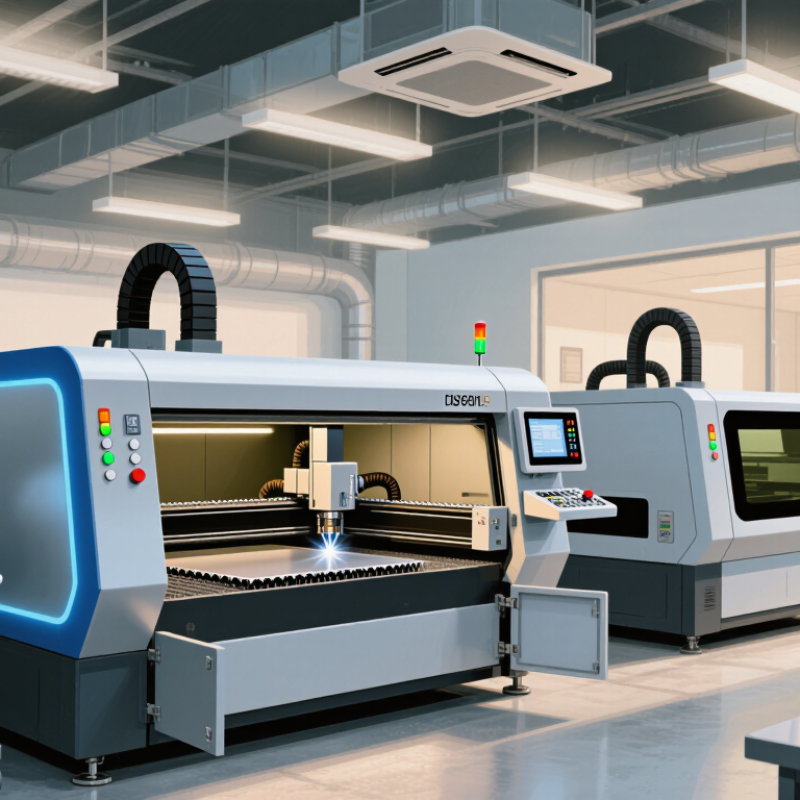
Choosing laser equipment begins with a business decision, not a machine specification. Define the products, materials, volumes, and tolerances you must handle. A sheet-metal shop may need fast cutting, while a medical-device supplier may prioritize repeatability and traceability. Different goals require different laser sources, powers, work areas, and automation levels.
According to Grand View Research, the global laser cutting machine market was valued at approximately USD 6.83 billion in 2023. Its projected growth reflects wider industrial adoption, but growth alone does not justify an expensive purchase. Estimate monthly production, acceptable scrap, operator time, maintenance, and energy consumption. Then calculate the cost per finished part. Keep it practical. A laser rated for thick steel may be wasteful for frequent thin-sheet work.
Application testing is essential. Send representative materials, including the most difficult grade and tightest tolerance, to a qualified equipment provider. Request measured results for cut speed, edge quality, kerf width, heat-affected zones, and repeatability. ISO 11553 provides safety requirements for laser processing machines, so include guarding, extraction, interlocks, and operator training in the specification. These details are often treated as secondary. They should not be.
A clean spreadsheet can still miss workflow problems. For example, loading delays may erase the productivity gained from higher power. Recheck the assumptions after a pilot run, especially when materials, staffing, or order sizes may change.
How to Choose the Best Laser Equipment for Your Business - Define Your Business Goals and Laser Application Requirements
| Business Goal | Typical Laser Application | Suitable Laser Category | Common Materials | Typical Wavelength | Key Performance Requirements | Recommended Priority | Important Selection Considerations |
|---|---|---|---|---|---|---|---|
| Permanent product identification | Serial numbers, barcodes, QR codes, logos and traceability marks | Fiber marking laser | Stainless steel, aluminum, carbon steel and many engineering plastics | Approximately 1,064 nm | High marking contrast, repeatability, fast cycle time and stable focus | High | Choose based on material reflectivity, marking depth, field size and required code quality. |
| Fine engraving and detailed graphics | Jewelry engraving, instrument scales, small components and decorative patterns | Short-pulse fiber or ultrafast laser | Precious metals, stainless steel, ceramics and selected polymers | Approximately 1,064 nm; ultrafast systems may use other wavelengths | Small spot size, low heat input, precise motion control and high positional accuracy | High | Shorter pulse duration can reduce heat-affected areas, but equipment cost and process complexity are usually higher. |
| Sheet-metal cutting | Cutting profiles, brackets, panels and fabricated metal parts | Continuous-wave fiber cutting laser | Mild steel, stainless steel, aluminum, brass and copper | Approximately 1,064 nm | Optical power, cutting speed, beam quality, autofocus and assist-gas control | High | Required power depends strongly on material type, thickness, cut quality, production volume and allowable cycle time. |
| Non-metal cutting and profiling | Cutting signs, packaging components, gaskets, prototypes and interior parts | CO₂ laser | Acrylic, wood, paper, cardboard, leather, fabric and some rubber materials | Approximately 9.3–10.6 µm | Clean edge quality, suitable bed size, extraction capacity and controlled thermal input | High | Material composition must be verified before processing; chlorine-containing plastics can release hazardous gases. |
| Welding and joining | Precision welding of assemblies, housings, tubes and battery-related components | Fiber welding laser | Stainless steel, carbon steel, aluminum, copper and nickel alloys | Approximately 1,064 nm | Stable energy delivery, beam control, shielding gas management and joint fit-up | High | Reflective metals may require specialized process settings, optics and safety controls. |
| Surface cleaning and coating removal | Rust removal, paint stripping, oxide cleaning and mold maintenance | Pulsed fiber cleaning laser | Steel, aluminum, stone, selected coated surfaces and tooling | Approximately 1,064 nm | Adjustable pulse energy, scanning control, low substrate damage and effective fume extraction | Medium | The process window should be tested to remove contamination without changing the base material. |
| Plastic marking and color change | High-contrast marks, melt marking, foaming and component identification | UV, fiber or CO₂ marking laser, depending on polymer formulation | ABS, polycarbonate, nylon, POM and engineered plastics | Approximately 355 nm, 1,064 nm or 9.3–10.6 µm | Material-specific contrast, low heat distortion, fume control and repeatable focus | High | The same polymer family may respond differently because pigments, additives and fillers affect laser absorption. |
| Glass and transparent-material processing | Surface marking, internal marking, drilling and controlled micro-processing | UV or ultrafast laser | Glass, quartz, sapphire and selected transparent polymers | Approximately 355 nm or shorter-pulse infrared systems | Low thermal damage, precise focus, vibration control and suitable pulse duration | Medium | Internal marking and brittle-material processing require application trials to control cracking and optical distortion. |
| High-volume automated production | In-line marking, inspection-linked processing and robotic laser workstations | Integrated fiber, CO₂ or diode laser system | Metals, plastics, wood, packaging and assembled products | Depends on the material and process | High uptime, automation interfaces, rapid loading, process monitoring and service support | High | Evaluate total cycle time, integration effort, preventive maintenance, operator training and production downtime risk. |
| Low-volume prototyping and customized products | Short-run parts, samples, personalization and design verification | Compact fiber, CO₂ or diode laser system | Depends on the product range | Depends on the material and desired effect | Flexible software, quick setup, moderate operating cost and broad material compatibility | Medium | A versatile system may provide better business value than a high-power machine when product mix changes frequently. |
| Laboratory or research development | Process development, parameter testing and material characterization | Adjustable pulsed, ultrafast or tunable laser platform | Metals, ceramics, polymers, glass and experimental materials | Application-dependent | Wide parameter range, interchangeable optics, measurement access and precise control software | Low | Prioritize experimental flexibility and data collection rather than production speed alone. |
| Safe and compliant workplace operation | Enclosed marking, cutting, welding or cleaning workstation | Class 1 enclosed system or appropriately controlled laser workstation | All materials, depending on the process | Process-dependent | Interlocked enclosure, emergency stop, key control, extraction and documented risk assessment | High | Laser classification, protective eyewear, ventilation and operator training should be assessed before purchase and installation. |