Why Choose Custom Coffee Bags for Your Brand?
Custom Coffee Bags do more than carry roasted beans. They protect aroma, communicate quality, and shape the customer’s first physical impression. A fresh bag should feel firm in the hand, display a clear roast date, and open without scattering grounds across the counter. Small details matter.
Samo Smrke, a coffee scientist and packaging researcher, has said, “Coffee packaging is part of coffee quality, not merely its decoration.” This idea deserves attention. A well-designed bag can use high-barrier materials, reliable heat seals, and a one-way degassing valve. These features help limit oxygen, moisture, and light exposure after roasting. They also support more consistent flavor during storage and transport.
Custom design gives a brand control over color, typography, size, and practical information. It can distinguish a matte black espresso pouch from a bright, approachable filter-coffee bag. It can also show origin, processing method, brewing guidance, and recycling instructions without creating visual clutter. The result feels intentional.
But customization is not magic. A beautiful pouch cannot rescue stale coffee or weak sealing. Some multilayer structures protect beans well but complicate recycling. That trade-off needs honest evaluation. Brands should compare barrier performance, production volumes, filling equipment, and regional disposal systems before ordering.
The best Coffee Bags balance protection, usability, appearance, and responsible material choices. They make a promise at the shelf. The coffee must keep it.
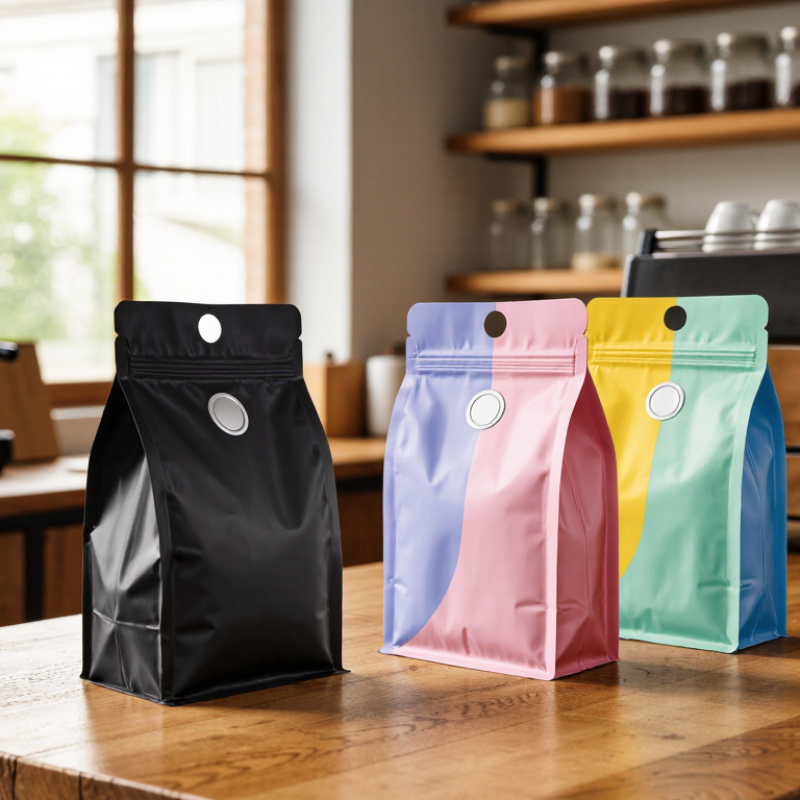
Custom coffee bags are packaging made to match a coffee product’s specific needs. Roasters can select the bag size, shape, material, printing, closure, and valve. These details are not merely decorative. A high-barrier inner layer helps limit oxygen, moisture, and light exposure. A one-way degassing valve allows carbon dioxide to escape after roasting.
The bag is part of the product experience.
The National Coffee Association’s 2024 Spring National Coffee Data Trends report found that 67% of American adults drank coffee during the previous day. That figure shows strong daily demand, but it does not prove that custom packaging alone drives sales. Packaging still has a practical role. A clear roast date, readable origin information, and a reliable seal can support consumer trust.
In production, customization requires testing. Different roast levels release different amounts of gas. A dark roast may need more headspace or a stronger valve. A delicate light roast may need better protection from oxygen. The Flexible Packaging Association reports that flexible packaging remains valued for its lightweight structure and efficient material use. However, “sustainable” should not be treated as an automatic claim. Mixed materials can be difficult to recycle, and that limitation deserves honest communication.
A thoughtful custom bag balances freshness, handling, shelf visibility, and environmental impact. It should protect the coffee first. Fancy printing comes later.
Custom coffee bags protect quality by controlling oxygen, moisture, light, and carbon dioxide. The 2024 National Coffee Data Trends report found that 67% of American adults drank coffee the previous day. That demand increases pressure on roasters to preserve freshness after packing. Coffee beans can lose aroma quickly when oxygen enters through weak seals or porous materials. High-barrier films reduce this exposure. Dark outer layers also limit light damage during storage and transport.
A one-way degassing valve releases carbon dioxide without allowing oxygen inside. This matters because freshly roasted coffee continues releasing gas for days. Without a valve, pressure may distort the bag or weaken its seal. According to the USDA Coffee: World Markets and Trade report, global coffee production was forecast at 176.2 million 60-kilogram bags for 2024/25. At that scale, small packaging failures can create major quality losses. Custom formats allow different roast levels, filling weights, and valve positions to receive suitable protection.
Still, a custom bag is not magic. Poor sealing, excessive heat, or long warehouse storage can damage coffee despite attractive packaging. I would test seal strength, oxygen transmission, and moisture protection before approving production. Packaging choices also involve trade-offs. A thicker barrier may protect aroma better, but it can complicate recycling. The best specification depends on roast profile, shipping time, and storage conditions.
Custom coffee bags do more than protect roasted beans. They give customers a visual reason to remember your brand. In packaging reviews, teams often see shoppers pause when colors, type, and materials feel consistent. Deep green may suggest calm and craft. A bright label can signal energy. These signals work before anyone reads the tasting notes. That matters on crowded shelves and online product pages.
A strong design repeats recognizable details across every bag size. Use one core color, a clear logo position, and a distinct illustration style. Keep the roast name easy to find. Customers should identify the bag from several feet away. A matte finish may communicate softness, while a small foil area can highlight freshness without overpowering the design. The bag also needs practical information, including roast date, origin, weight, and storage guidance. Clear facts make visual promises more credible.
Custom designs can express a brand’s working values. Recyclable structures, restrained ink coverage, or textured paper may support a thoughtful identity. These choices require verification, not attractive claims. Ask suppliers for material specifications and test seals, valves, and print quality before ordering widely. One imperfect sample can reveal weak contrast or a confusing message. That feedback is useful. Brand identity is not only what designers intend; it is what customers remember, understand, and trust after handling the bag.
Why Choose Custom Coffee Bags for Your Brand?
Custom coffee bags let a roaster match packaging performance with product needs. The material should protect beans from oxygen, moisture, light, and aroma loss. Common structures include kraft paper with barrier layers, high-barrier plastic films, and aluminum-based laminates. Each option behaves differently during filling, transport, and storage. Recyclable mono-material films may simplify recycling in some markets. However, local collection systems still matter.
Brands can customize bag size, gusset depth, print coverage, surface finish, and opening style. A matte surface feels soft and understated. Glossy film creates sharper color contrast. A one-way degassing valve helps release carbon dioxide after roasting while limiting outside air. Resealable zippers support repeated use at home. Tear notches improve opening. Small details matter.
They also affect cost. A stronger barrier may extend freshness, but it can increase material use and production expense. Compostable packaging sounds appealing, yet it needs suitable facilities and clear disposal guidance. This part is often misunderstood. Packaging teams should request migration data, barrier test results, seal-strength checks, and storage trials before approving a structure. A beautiful bag is not automatically a reliable bag. Minor changes in seal temperature or valve placement can cause real failures, so practical testing should guide the final specification.
Choosing the right coffee bag starts with the coffee, not the artwork. Roast level, oil content, grind size, and degassing speed determine the packaging structure. Dark roasts often need stronger oxygen and light protection. Freshly roasted coffee also releases carbon dioxide, so a one-way valve can prevent pressure buildup without inviting outside air.
The National Coffee Association’s Spring 2024 report found that 67% of American adults drank coffee the previous day. That demand creates pressure for reliable shelf performance. Meanwhile, the International Coffee Organization’s 2024 Coffee Development Report estimated global consumption at about 177.9 million 60-kilogram bags in 2023/24. Even small packaging failures can become expensive at that scale.
A brand should compare barrier data, not only appearance. Ask suppliers for oxygen transmission rate, moisture protection, seal strength, and migration testing. Choose a flat-bottom, side-gusset, or quad-seal format according to filling equipment and shelf geometry. A resealable zipper helps frequent users, while a simple heat seal may suit smaller portions and lower costs.
Test the actual roasted coffee inside the proposed bag. Laboratory results cannot fully predict warehouse heat, shipping vibration, or repeated opening. I would also question vague claims such as “eco-friendly” without material details or recovery guidance. A perfect bag does not exist. Sometimes, a thinner structure performs well; sometimes, it fails after one humid season. Small pilot runs reveal that uncomfortable truth.
| Decision Dimension | Why It Matters | Custom Coffee Bag Advantage | Recommended Evaluation Criteria | Best-Fit Use Case |
|---|---|---|---|---|
| Brand Differentiation | Coffee packaging is often the first physical brand touchpoint on a retail shelf or online product page. | Custom artwork, color systems, typography, and structural details create a recognizable package identity. | Check logo visibility, shelf impact, readability, and consistency across product variants. | Retail launches, subscription programs, specialty coffee lines, and premium positioning. |
| Aroma and Oxygen Protection | Roasted coffee is sensitive to oxygen, moisture, light, and heat, which can accelerate quality loss. | The bag structure can be selected for the required barrier level instead of relying on a standard material. | Request oxygen transmission rate, moisture vapor transmission rate, light protection, and seal-performance data. | Whole-bean coffee, ground coffee, premium roasts, and products with longer distribution cycles. |
| Degassing Function | Freshly roasted coffee releases carbon dioxide; uncontrolled gas buildup can affect package integrity. | A one-way degassing valve can release internal gas while helping limit oxygen entry. | Confirm valve compatibility with roast freshness, fill volume, bag format, and sealing equipment. | Recently roasted coffee sold before extended storage or long-distance transportation. |
| Bag Format and Capacity | Different serving sizes and filling methods require different dimensions, gussets, and closure systems. | Dimensions can be optimized for common pack sizes such as single-serve, small retail, or bulk formats. | Evaluate fill weight, bag volume, shelf footprint, gusset stability, and compatibility with filling lines. | Brands offering multiple weights or packaging coffee for both retail and food-service channels. |
| Closure and Resealability | A reliable closure helps consumers protect unused coffee after opening. | Options may include heat seals, zippers, tin ties, or other closures selected for the intended user experience. | Test seal strength, zipper performance, leak resistance, opening convenience, and repeated use. | Household consumers, premium retail products, and coffee purchased for gradual consumption. |
| Material and Sustainability Goals | Packaging choices affect resource use, product protection, waste management, and communication of environmental claims. | The material structure can be selected around the required barrier performance and the available local recycling or composting infrastructure. | Verify material composition, recyclability pathway, certification evidence, disposal instructions, and claim compliance. | Brands with defined sustainability targets and access to relevant end-of-life systems. |
| Printing and Information Design | Packaging may need to communicate roast level, origin, tasting notes, weight, preparation guidance, and regulatory information. | The artwork can allocate clear zones for required information while maintaining a coherent visual hierarchy. | Review print sharpness, color consistency, barcode readability, contrast, and legal labeling space. | Multi-product ranges, educational packaging, and products sold through regulated markets. |
| Minimum Order and Inventory Risk | Printed packaging usually requires production planning, and excess bags can become obsolete after a design or product change. | Artwork and order quantities can be planned around forecasted demand, product rotation, and reusable design elements. | Compare minimum order quantity, unit cost at each volume, storage requirements, lead time, and artwork change costs. | Growing brands that need a balance between customization and inventory flexibility. |
| Production Compatibility | A visually attractive bag may still create filling, sealing, or handling problems if it does not match production equipment. | Dimensions, film stiffness, seal areas, and opening design can be specified for the intended packaging process. | Test machine fit, seal temperature range, line speed, bag feeding, valve placement, and tolerance control. | Roasters using automated, semi-automatic, or contract-filling operations. |
| Consumer Convenience | Easy opening, stable storage, clear labeling, and resealing can improve the everyday product experience. | The package can be designed around handling, pouring, storage, and repeat use rather than appearance alone. | Conduct practical user testing for grip, opening force, resealing, standing stability, and storage efficiency. | Direct-to-consumer products, gift sets, subscription shipments, and premium everyday coffee. |
| Quality Assurance | Consistent barrier performance, dimensions, seals, and print quality help reduce leakage, damage, and customer complaints. | A custom specification can define measurable acceptance limits before mass production begins. | Request pre-production samples, certificate documentation, batch inspection, seal testing, and color proof approval. | Any coffee product where freshness, presentation, and repeat purchasing are important. |
Note: The appropriate coffee bag depends on roast freshness, distribution time, fill weight, equipment, local disposal infrastructure, and applicable packaging regulations. Barrier and performance specifications should be verified through supplier documentation and product testing.
Call 815-281-5297 now to speak directly with an Algus expert or fill out the form below.